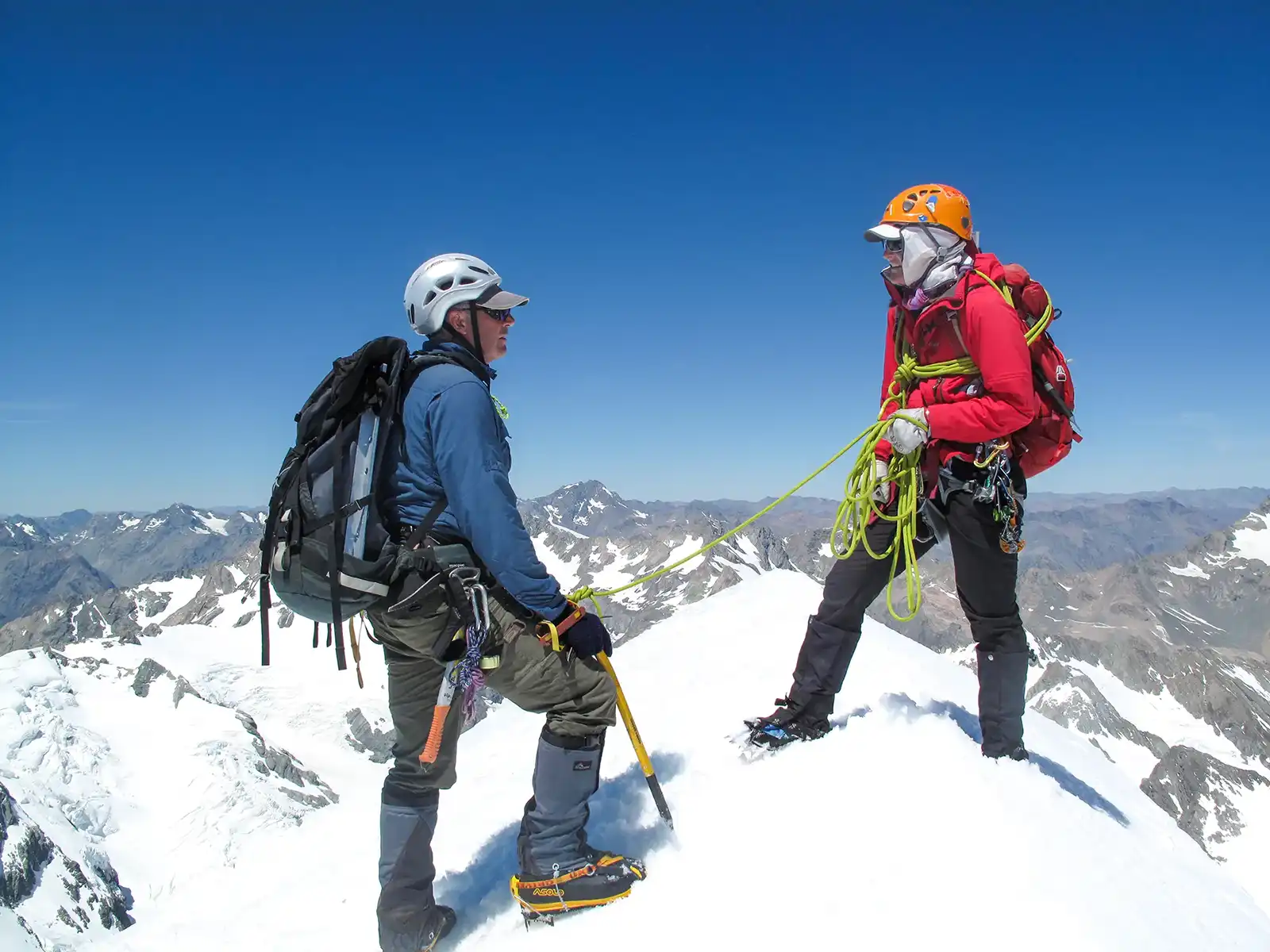
Based in Aoraki/Mount Cook National Park — the home of New Zealand mountaineering — we have the country’s highest peaks and largest glaciers on our doorstep. We also guide in Westland, Fiordland, Aspiring, and the Remarkables.
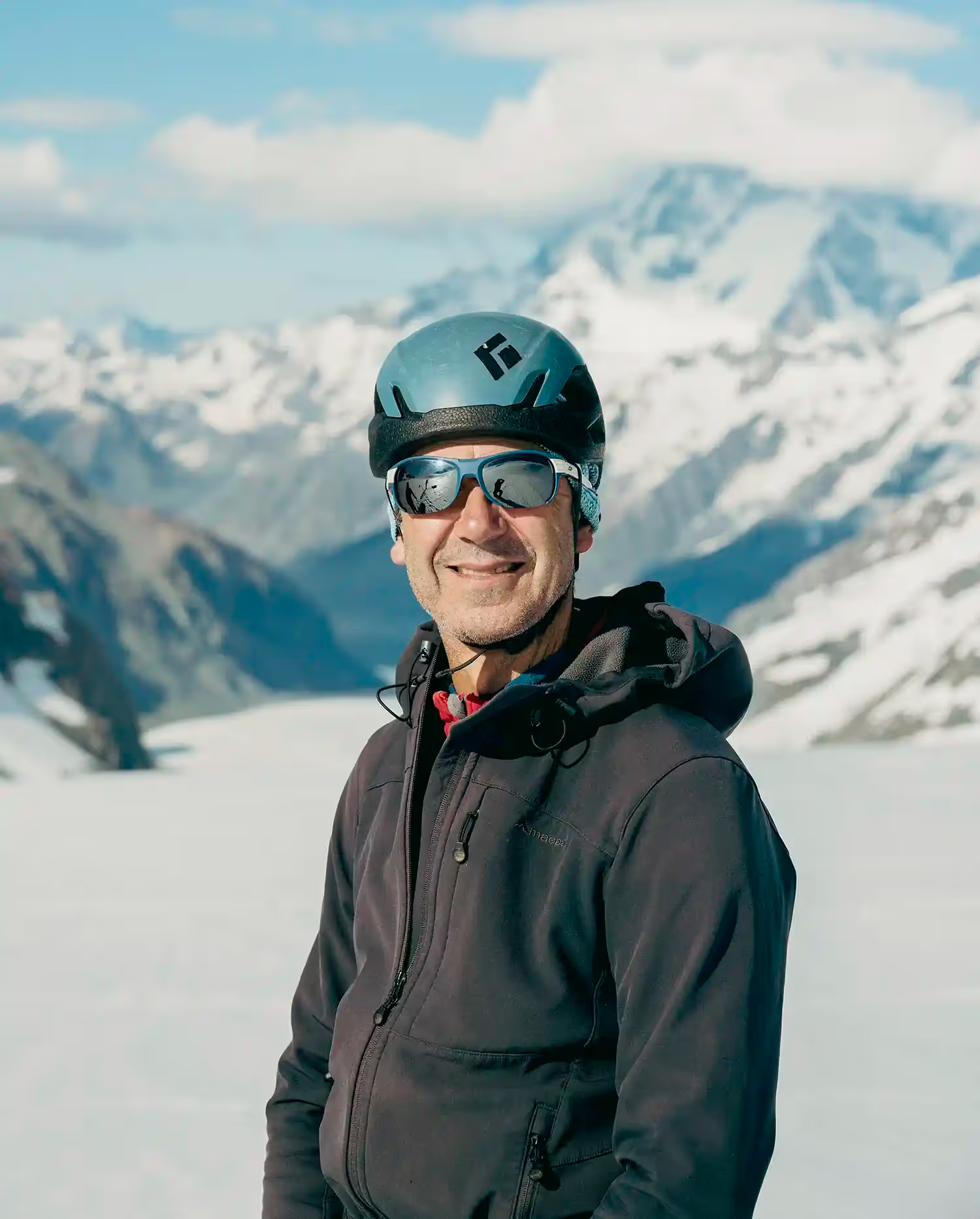
Our guides are fully qualified professionals through the NZMGA and IFMGA, bringing world-class expertise to every trip.
Mountain guiding isn't about avoiding risk; it’s about managing it. We guide you through demanding terrain and breathtaking peaks, pushing your skills while keeping safety at the center of every decision. Our programs are refined through decades of experience—not just marketing hype.
Every trip includes what you need for a successful experience, with no hidden costs. We value honesty and clarity in everything we offer.
We provide the latest, highest-quality technical equipment — modern, well-maintained and superior to what’s typically offered elsewhere. Every climber has access to gear they can trust, ensuring safety, performance, and comfort in the alpine environment.
We operate with full 7-day base support, reliable communications, air transport coordination, local accommodation links, avalanche forecasting, and free use of technical equipment.

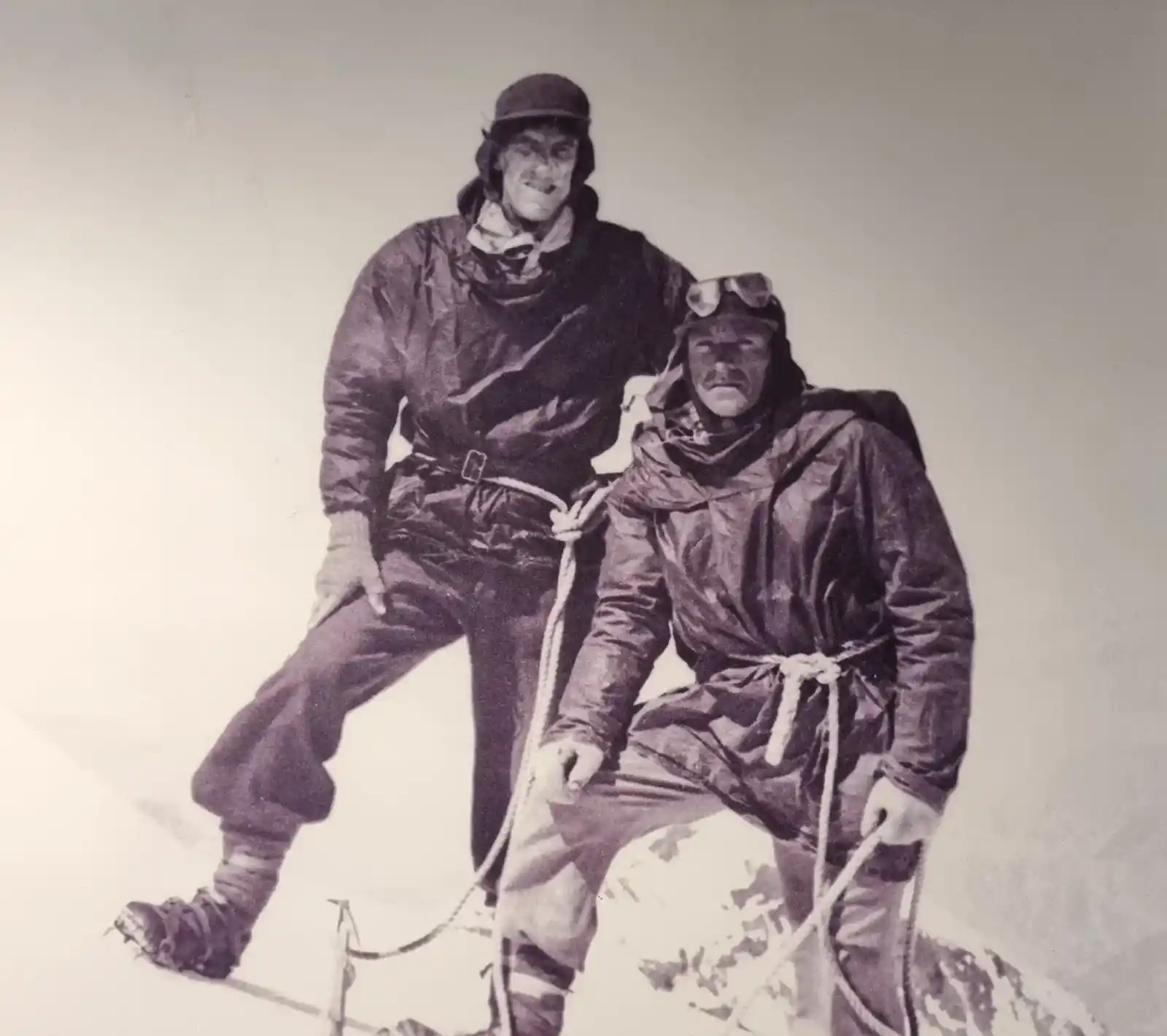
The profession all but expired after WW2. Demand fell as belts were tightened. New Zealand, through post-war austerity and necessity, became a DIY nation. Most training, if there was any, became the territory of the mountain clubs.
In 1953 the former Hermitage Chief Guide, Harry Ayres, became the first Chief Ranger of the very new Mount Cook National Park. As a result, former guides were suddenly government employees, and professional guiding ceased for some time.

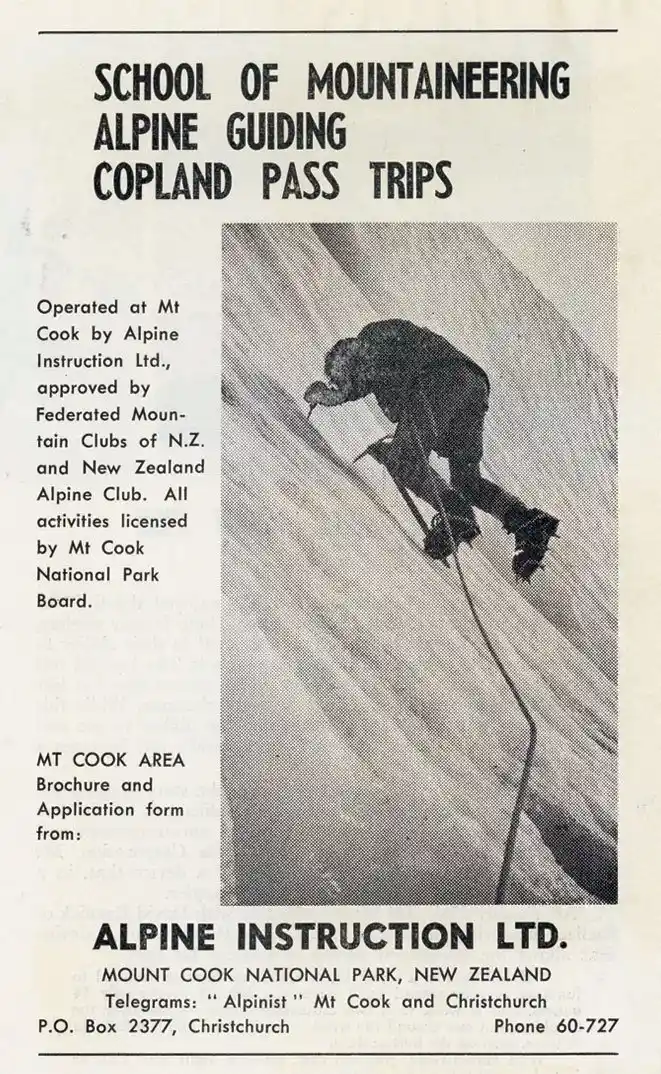
In 1966 three young Christchurch-based mountaineers, Lynn Crawford, Peter Farrell and Bruce Jenkinson, as well as Australian Geoff Wyatt, realised there was a niche for professional mountain tuition. They founded Alpine Instruction Ltd to “rekindle” the golden age of professional guiding. The first trip was from the 6th to the 10th of December 1966. Aat Vervoorn guided Peter Wagner to Tasman Saddle, with an ascent of Hochstetter Dome, and “7/8ths of Elie de Beaumont”.
Alpine Instruction boasted the names of legendary guides Mick Bowie and Harry Ayres, and also Edmund Hillary on their list of “reputable, expert advisors”. The guides ranged widely from Mount Cook to the West Coast, with climbers, skiers, and even hunters as guests. Many of their missions would not at all be possible in our more regulated times…
As instruction widened into guiding, the business became Alpine Guides (Mount Cook) Ltd in 1971 and was subsequently owned by larger businesses, until being bought by guides Bryan Carter and Kevin Boekholt in 2000, forming Alpine Guides (Aoraki) Ltd.
More than a half-century later, Alpine Guides has seen the establishment of Aoraki Mount Cook National Park and the NZ Guides Association becoming affiliated with the IFMGA. During this time, many other NZ guiding outfits have come and gone.
These days, the effects of climate change are biting ever deeper into our precious glaciated landscape. This is probably the biggest challenge we face going into the 21st Century.

From its inception, AGL established a reputation for high standards and industry-leading practice. It fought hard to raise training levels and establish standards consistent with international levels. We began ski guiding in the mid-1970s, with heliskiing now a major recreational industry in NZ.
Today, we are more diverse than ever, but mountain guiding is still the core of our business.
We should acknowledge the trust and experience earned through generations of profound, thoughtful dedication to safety and professionalism. In these times of rapid change, experience is a rare commodity that should be embraced.
For nearly six decades, Alpine Guides has shaped the story of New Zealand mountaineering. From pioneering routes to training generations of climbers, our heritage is built on experience, respect for the mountains, and a commitment to guiding that stands the test of time.

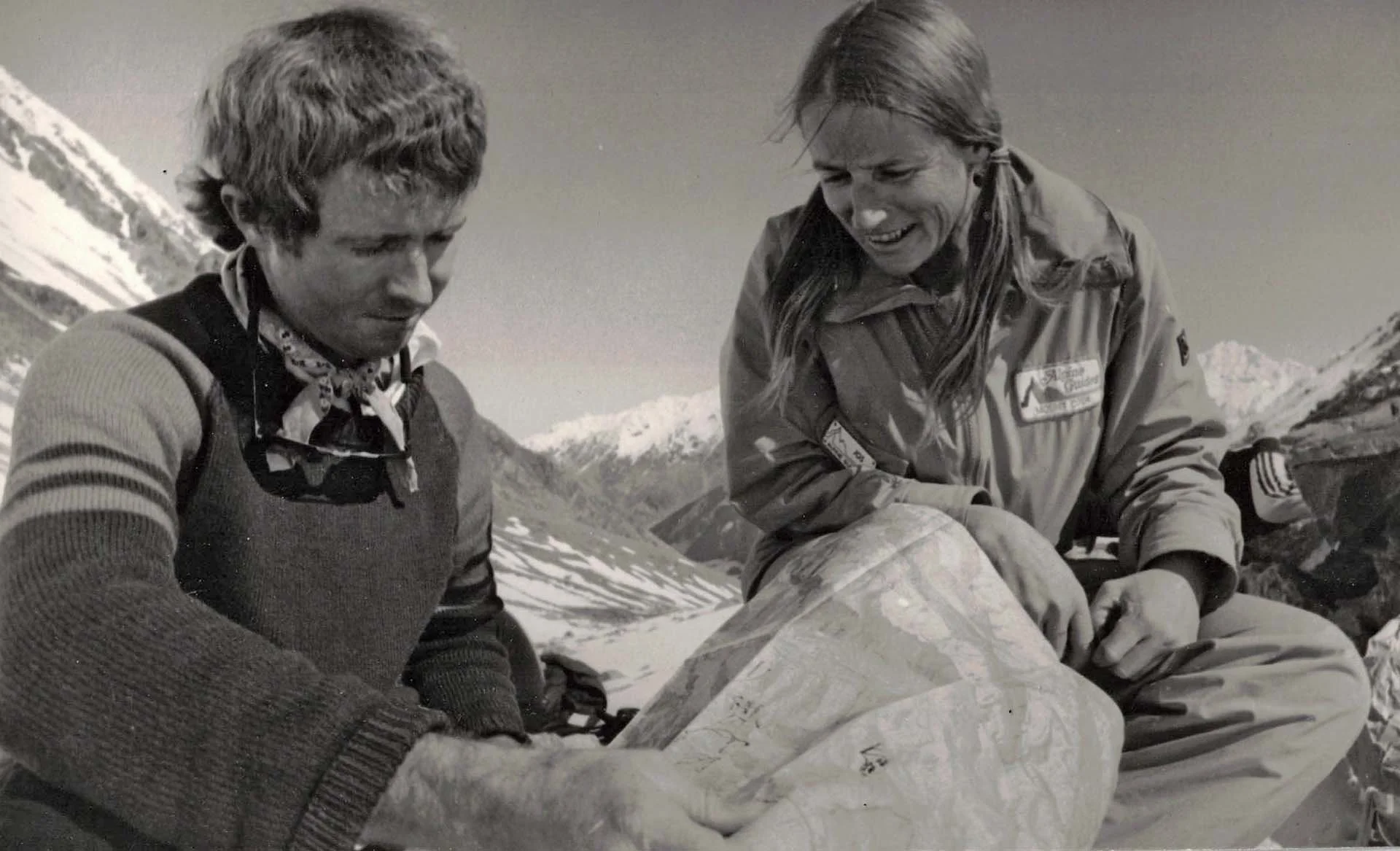
Bryan and Joss in the field with Mt Cook Heliski , Ben Ohau range, September 1985.

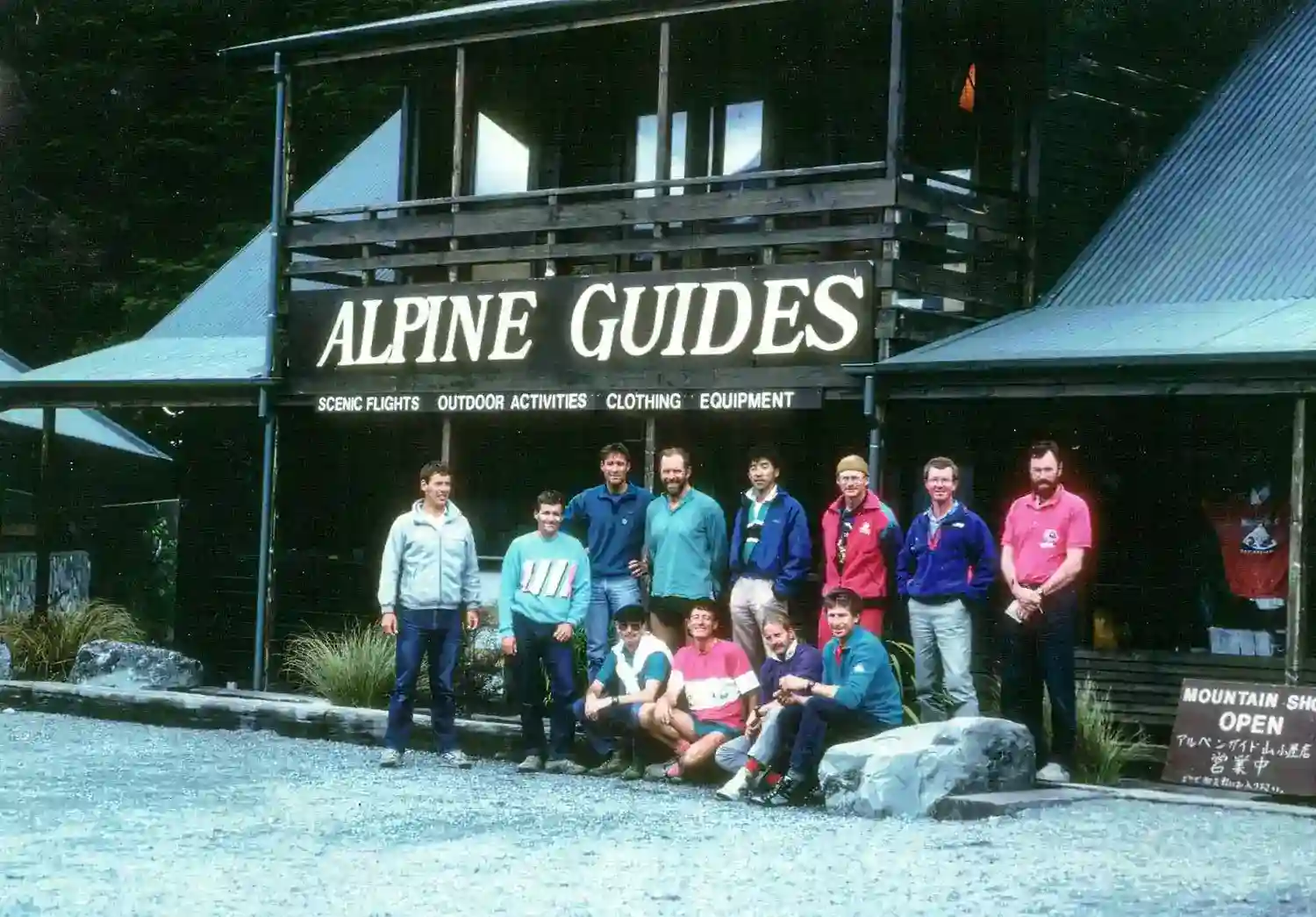
Outside the AGL base, still a gravel car park.
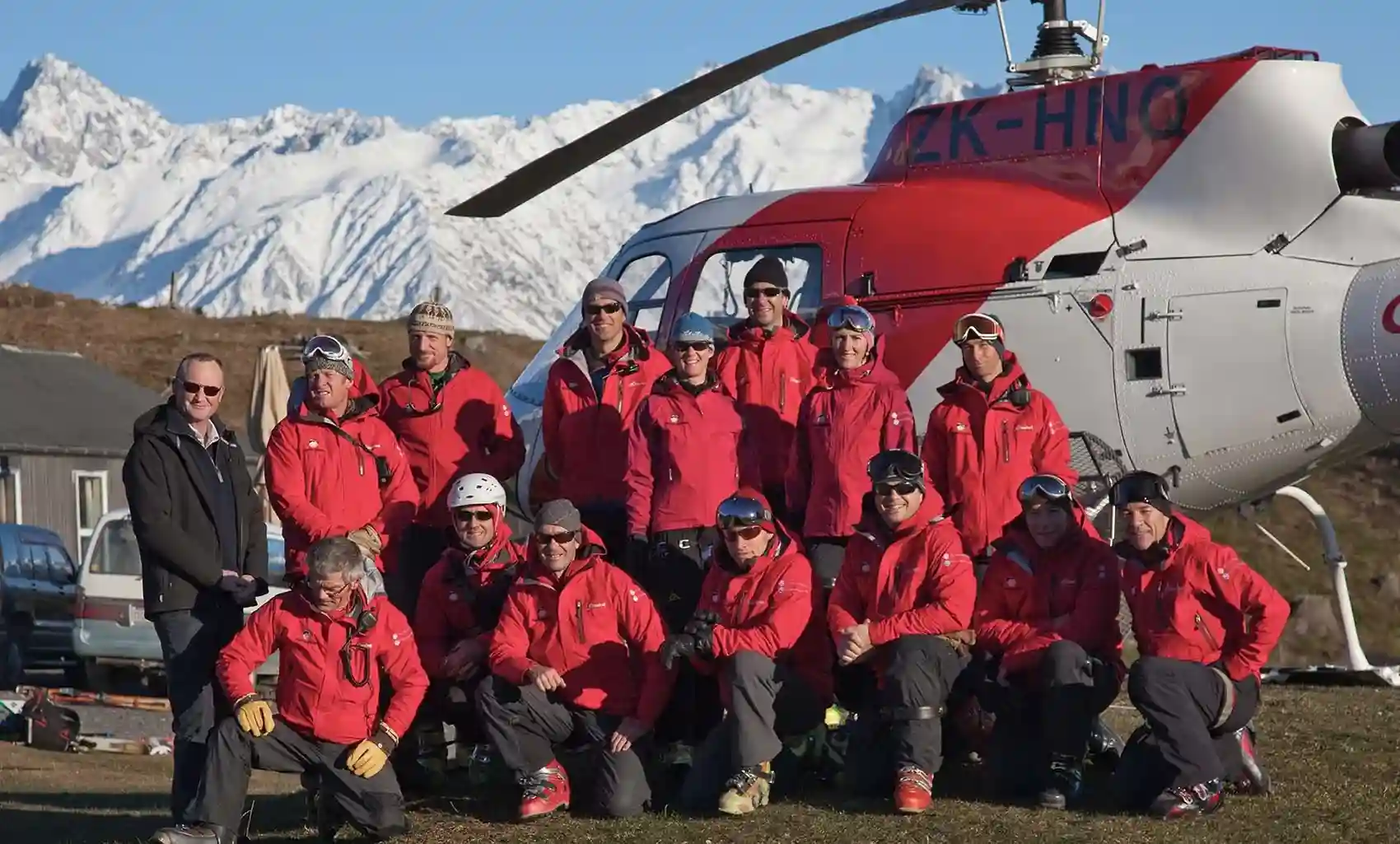
From L to R, Guy Cotter, John McNamee, Kevin Boekholt, Pete Brailsford, Shaun Norman, Kem Johnson, Hiro Yanagisawa, Charlie Hobbs, Bill Atkinson, Mike Roberts, Bryan Carter, Bob Munro.

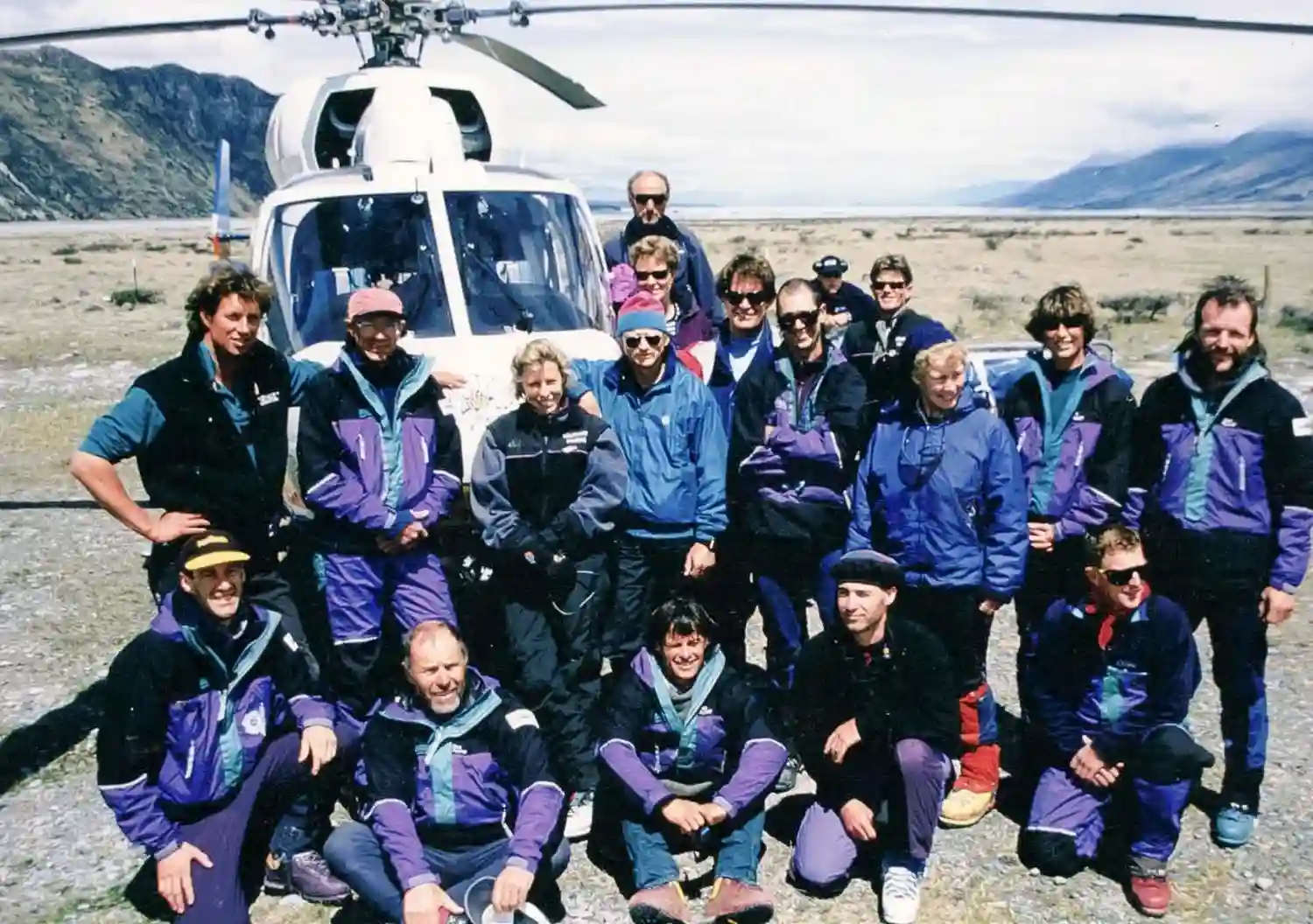
From left to right: Dave Crow, John Roberts (JR), Anton Woperies, Gerry Kennedy, Bill Atkinson, Andy Harold, Dave (Spoon) McCloud, Kem Johnson, Matt Wilkinson, Marty Beare, Russell Braddock, Brede Arkless, John MacNamee, and Gary Dickson.

During staff training summer of 1996-97, in front of a Mount Cook Group BK-117.
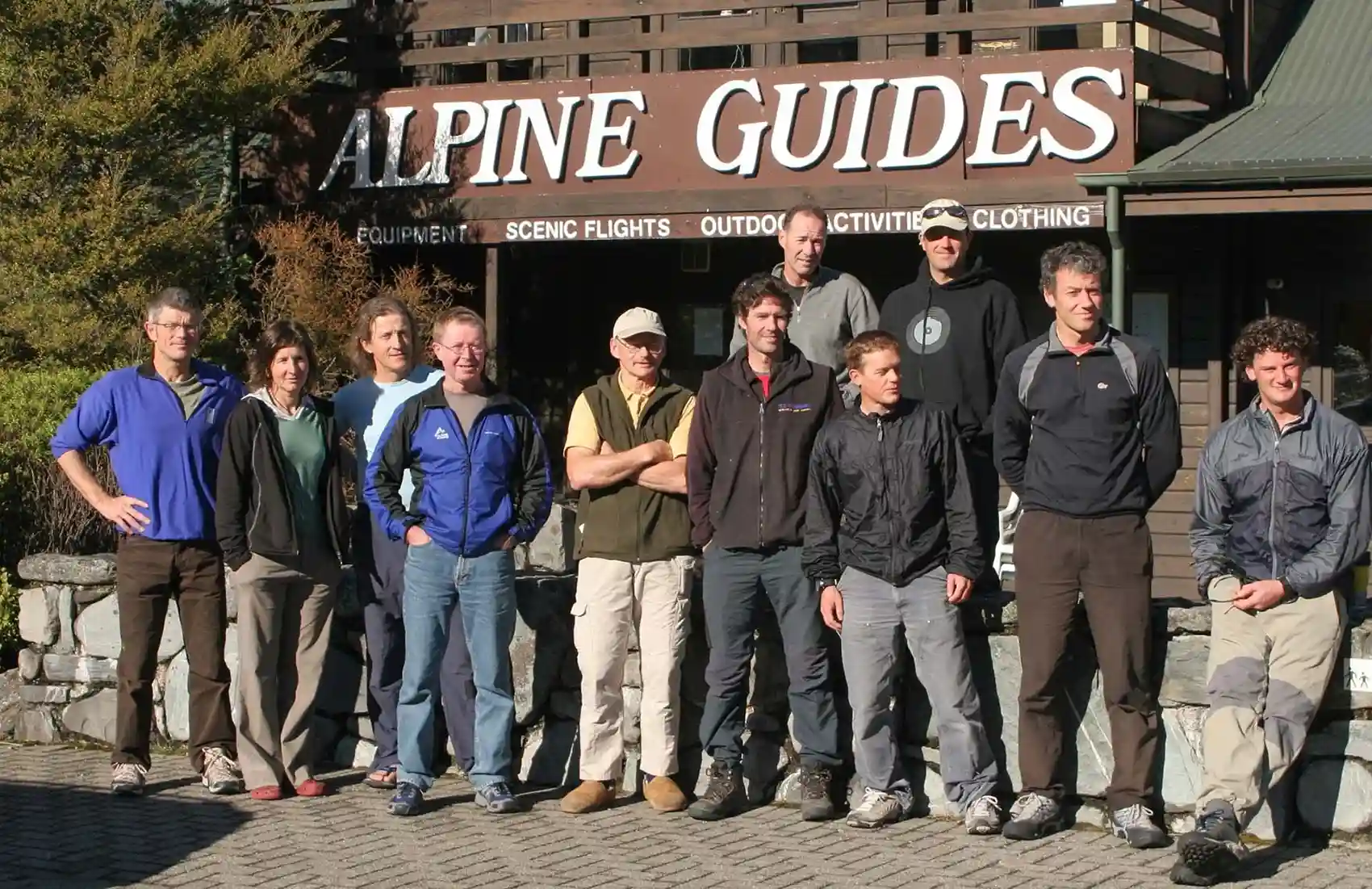
From L to R Tarn Pilkington, Gary Dickson, Anton Woperies, Shaun Norman, Anne Palmer, Bill Atkinson, Rachel Brown (behind Bill), Ray Button (behind Rachel), Dave Hiddleston (sitting), Whitney Thurlow, Sam Bosshard, Kevin Nicholas, Trev Streat, Brede Arkless, Kiersten Price, Paul Aubrey, Dean Staples.

Pre-winter staff training. From L to R, Trev Streat, Jo Haines, Roy Smith, Bryan Carter, Bill Atkinson, Dave McKinley, Kevin Boekholt, Jonny Morgan, Jamie Robertson, Danny Baillie, Tony Donaldson.

Ski guides training at Glenfalloch Station, winter 2010.
L to R, Philip Todhunter, Trev Streat, Al Moore, Sean Brooks, Gary Keuhn, Dave McKinley, Jamie Robertson, Laura Adams, Ben Taylor (front), Sam Bosshard, Paula Roberts, Mal Haskins, Roy Hawthorne, Andy Tindall, Kevin Boekholt.

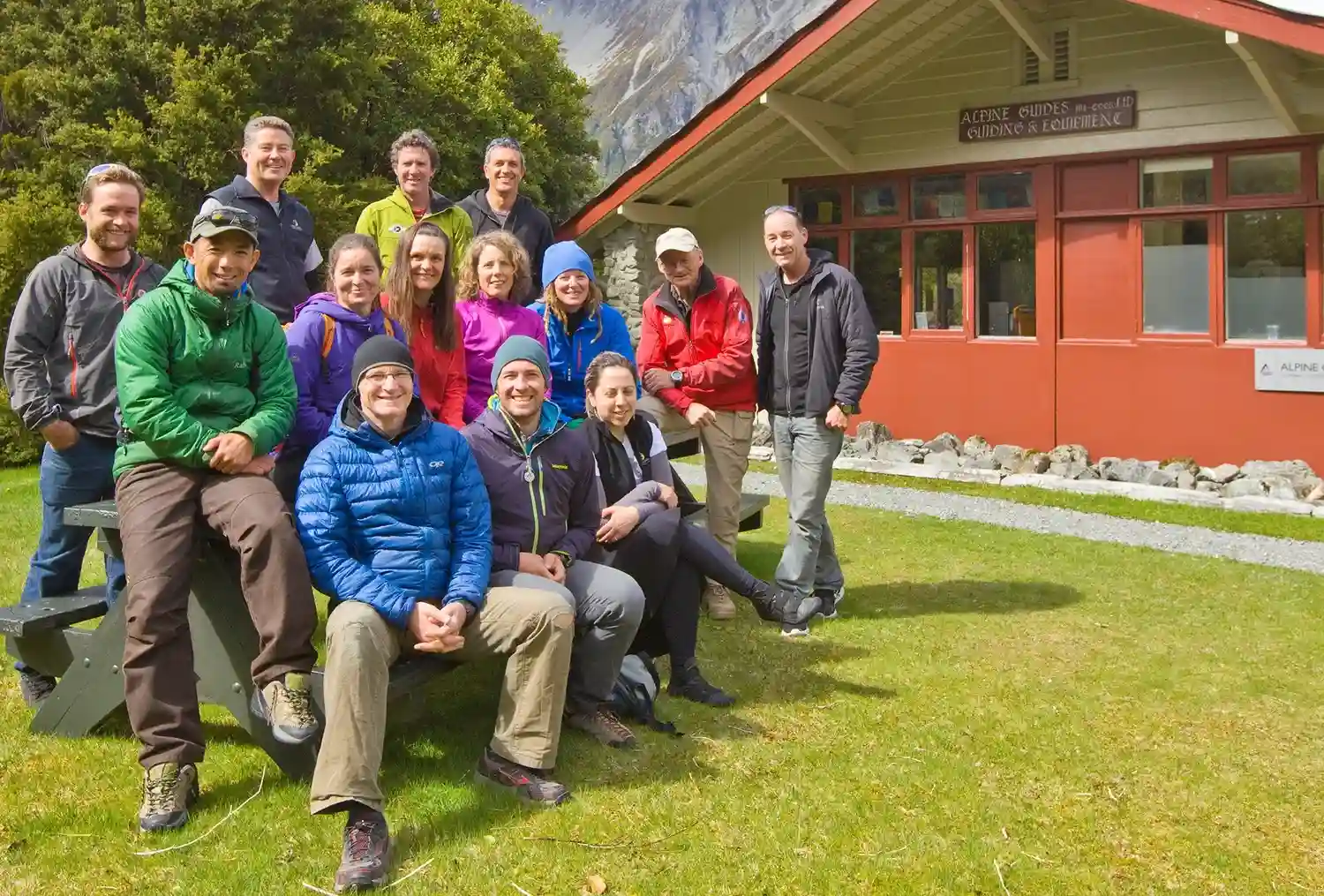
At summer training outside our temporary base at House One, Mt Cook Village. From L to R, Lewis Ainsworth, Tai Naka, Arthur McBride, Merrie-Beth Board, Dave Alderson, Dave McKinley (rear), Jane Morris, Abby Watkins, James Madden, Jamie Robertson (rear), Anna Loomes, Dani Mello, Bill Atkinson, Kevin Boekholt.


The NZMGA is the body that trains and certifies mountain guides in New Zealand. To work professionally as a guide you must be on the training pathway. The pathway allows for various disciplines, with the highest qualification being the “IFMGA” qualification.
A career in guiding is a major commitment. Full certification takes an average 10 years of experience and 5 years of working through a range of assessment courses. Visit the NZMGA for information on guiding certification.

Alpine Guides works closely with NZ's Department Of Conservation to minimise the impact of our activities on the mountain environment, the land, water, and to respect cultural heritage. We are privileged to operate within incredible world heritage areas. We work hard to maintain our concessions with the Department. Without these, we cannot operate in conservation estate.
Waste reduction, removal, and recycling
We carry out all waste material from our trips. There is very little food wastage. We buy fresh produce for each trip and have a bulk store. We have a waste sorting system to ensure recyclables are collected back at our base. Whenever camping or bivvying is required you will be provided with a very special container - for your own “waste”. On your mountain trip, you will be living in a beautiful and delicate environment. Please join us in endorsing the philosophy of “take only photographs, leave only footprints”.


The Kea (Nestor notabilis) is a true alpine parrot, endemic to the Southern Alps of New Zealand. These amazing and intelligent birds are sadly (like so much else) endangered. We are proud to financially sponsor the Kea Conservation Trust. Please visit the Trust's website to learn about current research projects, and how to support them.

Alpine Guides staff are volunteers in DOC’s efforts to eliminate introduced predators in Aoraki Mount Cook National Park. We run a line of 21 traps around Mount Cook Village.
Data from our traps is included in the Traps.nz network. This is part of the nationwide effort to reduce the introduced mammalian predators that have devastated NZ’s bird, insect, and reptile life.
Anyone in NZ can become a volunteer trapper. Find out more at Trap.nz.

Nau mai, haere mai ki Aotearoa. Welcome to New Zealand.
Tiaki means to care for people, places, and culture. Alpine Guides has taken this wero (challenge) to heart.
Te Wero - Our Challenge
In New Zealand, we welcome manuhiri (guests) in the spirit of manaakitanga (respect, kindness, and hospitality). We also present our visitors with a wero (challenge). This wero is a challenge and commitment to care for New Zealand. This wero is the Tiaki promise.
We encourage all visitors to pick up this wero. To follow the Tiaki Promise. To act as a guardian, protecting and preserving our home.

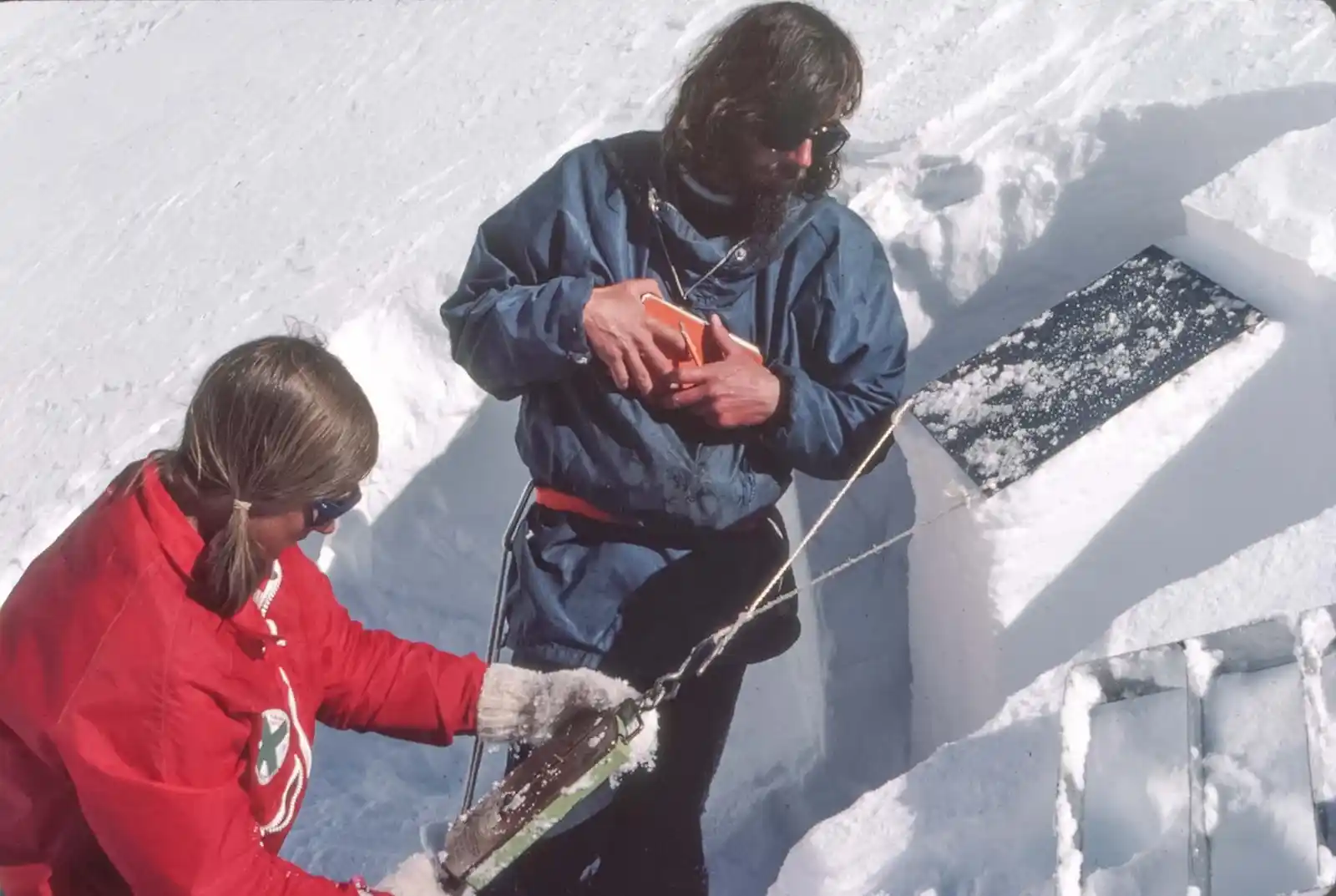
Our guides provide regional public avalanche forecasts for the Aroaki, Arthurs Pass, and Ohau areas. This data is available on Avalanche.net.nz. The network is operated by the Mountain Safety Council.
Avalanche forecasting is an invaluable tool for recreational and professional alpinists, and a serious responsibility for our team. Our guides use direct field observations, weather station data, public observations, and assistance from ski area patrollers to build a comprehensive picture of the snowpack and its potential risks.